
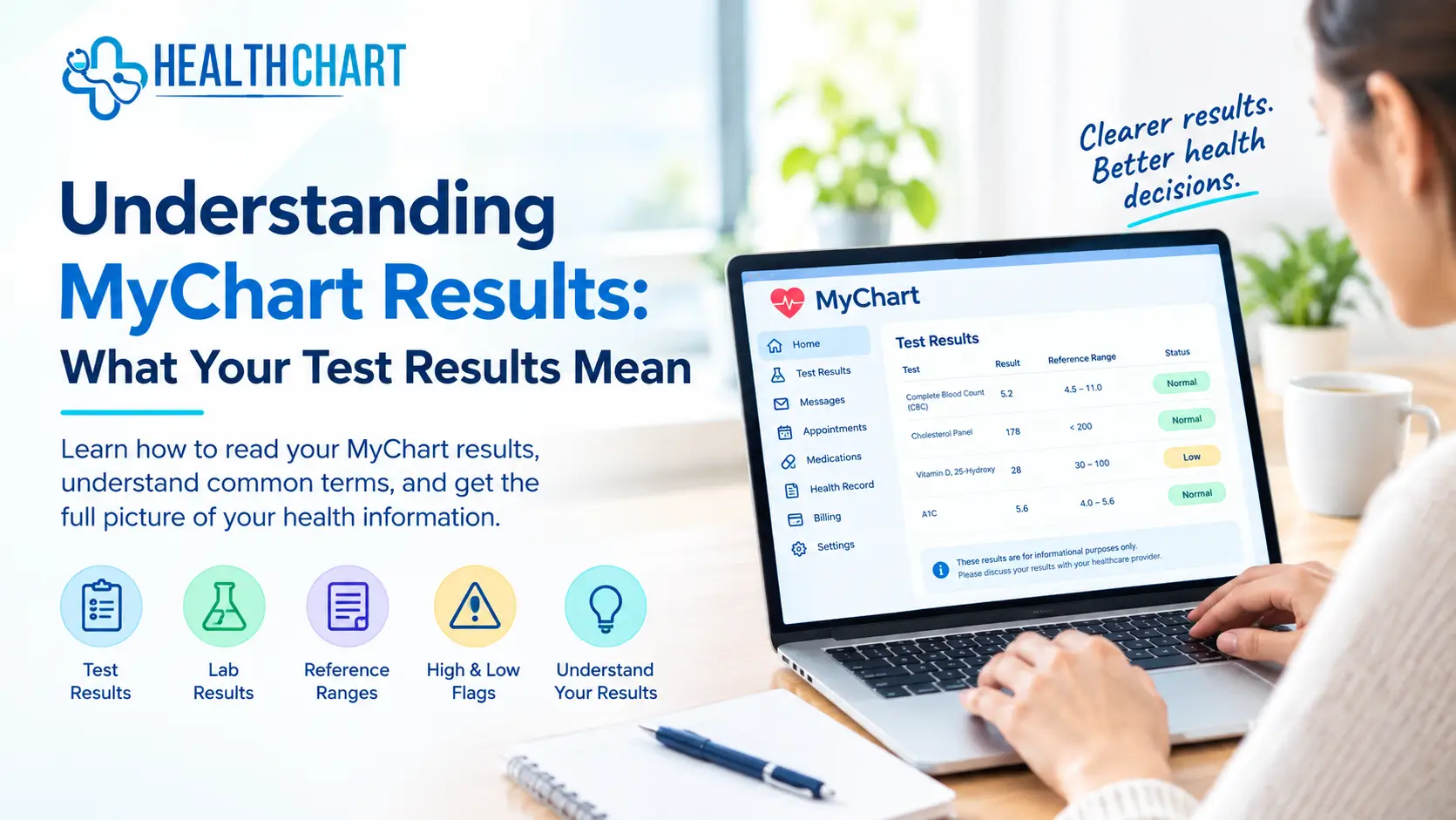
Getting a new test result in MyChart can sometimes leave you with more questions than answers.
You may see a number, reference range, high or low flag, or medical term that you do not recognize. Naturally, you may wonder whether the result is normal, what it means, and whether you need to do anything about it.
MyChart makes it easier to access health information that your healthcare organization has made available through its patient portal. Depending on the organization and the type of test, you may see laboratory results, reference ranges, provider comments, and previous results.
But an important point is worth remembering:
A MyChart result is not a diagnosis
Understanding an individual result may require looking at your symptoms, medical history, medications, physical examination, other test results, and the reason the test was ordered.
This guide explains how to read common information you may see in MyChart and how MyHealthChart can help you understand general medical terminology and health measurements. Pasted markdown
Important: MyHealthChart is an independent health-information website. It is not affiliated with or endorsed by Epic Systems Corporation or any healthcare organization that uses MyChart. We do not have access to your personal MyChart account or medical records.
What Do MyChart Results Show?
When a healthcare organization makes a test result available through MyChart, you may see several pieces of information.
Depending on the test and your healthcare organization’s setup, a result may include:
- Test name
- Your result or measured value
- Unit of measurement
- Reference range
- Date of the test
- Comments from your healthcare professional
- Previous results or trends
The way results are displayed can vary.
If you want to learn more about accessing your results, see our guide to MyChart test results.
What Is a MyChart Reference Range?
A reference range is a range of values used to provide context for a laboratory measurement.
For example, a blood test may display your result alongside a reference range. The range can help show whether your result falls within the range commonly expected by that laboratory.
However, a reference range does not automatically determine whether you are healthy or unhealthy.
Reference ranges can differ between laboratories because laboratories may use different testing methods, equipment, units, and reference populations.
For this reason, it is generally more useful to look at the reference range displayed with your specific MyChart result rather than comparing your number with a range found somewhere else online. Pasted markdown
What Does a High or Low MyChart Result Mean?
You may see a result marked High, Low, Abnormal, or Out of range.
This usually indicates that the reported value falls outside the displayed reference range.
However, an out-of-range result does not automatically mean that you have a medical condition.
A laboratory result can be affected by many factors, including:
- Age
- Sex
- Time of testing
- Food and drink
- Medications
- Physical activity
- Recent illness
- Hydration
- Medical history
- The reason the test was ordered
Your healthcare professional considers these factors when determining what a result means in your particular situation. Pasted markdown
What Does a Normal MyChart Result Mean?
A result that falls within the displayed reference range does not necessarily mean that everything is normal.
Laboratory results are only one part of a health assessment. Your healthcare professional may also consider your symptoms, medical history, physical examination, other test results, and changes over time.
Similarly, one result outside the reference range does not automatically mean that something serious is happening.
The meaning of a test result depends on context.
That is why you should avoid using one laboratory value by itself to determine whether you have a health condition. Pasted markdown
Why Does MyChart Flag a Result?
Some MyChart results may include an indicator showing that a value falls outside the displayed laboratory range.
Common terms may include:
- High
- Low
- Abnormal
- Out of range
The exact wording can vary depending on the laboratory and how your healthcare organization displays results.
A flag tells you that the value is outside the displayed range or deserves attention. It does not tell you why the result is abnormal.
If you see an unexpected flag, review the complete result and any comments provided by your healthcare professional. If you are still concerned, contact your healthcare provider for an explanation. Pasted markdown
Why Can the Same Test Have Different Reference Ranges?
You may notice that the reference range for the same type of test looks different on two reports.
This can happen because laboratories may use different:
- Testing methods
- Equipment
- Units
- Reference populations
Because of these differences, comparing the actual numbers without considering the corresponding reference range can be misleading.
When reviewing a MyChart lab result, start with the information displayed alongside that particular test. Pasted markdown
Why Did My MyChart Result Change Over Time?
A laboratory value can change between tests.
Changes may occur because of illness, medications, diet, physical activity, hydration, timing, testing conditions, or normal changes in the body.
Depending on your healthcare organization’s MyChart setup, you may be able to review previous results and look at trends over time.
A trend can provide useful information, but it should still be considered in its broader clinical context.
One change does not necessarily mean that your health is getting better or worse. Pasted markdown
How Can You Compare MyChart Results Over Time?
If your MyChart account provides result-tracking features, you may be able to compare older measurements with newer ones.
When comparing results, pay attention to:
- The date of each test
- The units
- The reference range
- Whether the same type of test was performed
- Any comments from your healthcare professional
Some MyChart users may also have access to result-trend or download features, depending on their healthcare organization’s implementation. Pasted markdown
If you notice a consistent change, discuss the pattern with your healthcare professional rather than trying to determine the cause yourself.
What If My MyChart Result Looks Wrong?
The information displayed in MyChart comes from the medical record maintained by your healthcare organization.
If you believe that information is incorrect, contact your healthcare provider or the appropriate medical records department.
An unusual result should not automatically be assumed to be a mistake simply because it does not match what you expected.
If you are concerned about a result, ask the healthcare professional who ordered the test to help explain it. Pasted markdown
Why Did I See My Result Before Talking to My Doctor?
You may sometimes see a test result in MyChart before your healthcare professional has discussed it with you.
This can happen when the result is released through your healthcare organization’s system.
The timing can vary depending on the organization and the type of test.
If you see a result that you do not understand, avoid immediately assuming the worst. Review the complete result, check for provider comments, and contact your healthcare team if you need an explanation. Pasted markdown
How to Read a MyChart Result
When you open a new result, start by reviewing the entire entry rather than focusing only on a high or low flag.
1. Check the Test Name
Make sure you know exactly which test you are looking at.
A blood test may be part of a larger group of tests, so check the specific name.
2. Look at Your Result
Review the reported number or measurement.
Also check the unit, because the same measurement can be reported using different units.
3. Check the Reference Range
Look at the reference range displayed next to your result.
Use the range provided for that particular test rather than relying on a general number from another website.
4. Check the Date
The test date is important, especially when comparing current and previous results.
5. Read Provider Comments
Your healthcare professional may include comments or explanations with your result.
Read these comments before drawing conclusions from the number alone. Pasted markdown
Can MyHealthChart Help You Understand MyChart Results?
Yes — for general health education.
If you see a medical term, laboratory test, or health measurement in your MyChart account that you do not understand, MyHealthChart can help explain what that test generally measures and why healthcare professionals may use it.
You can also explore educational resources about topics such as:
- Blood pressure
- Heart rate
- BMI
- Common laboratory tests
- General health measurements
- Nutrition-related measurements
Our health tools and educational articles are designed to explain general health concepts in plain language.
However, they cannot determine what your individual result means or provide a personal diagnosis. Pasted markdown
Can You Enter a MyChart Result Into a Health Tool?
An educational calculator or reference tool may help you understand a measurement you already have.
For example, if you have a blood pressure reading, you may use an educational blood pressure resource to learn more about how blood pressure is generally categorized.
If you have a laboratory result, you can also read an educational explanation of what that particular test measures.
But an online tool should not be treated as a diagnosis.
A health tool evaluates the information you enter according to its design. Your healthcare professional interprets your results in the context of your complete health picture. Pasted markdown
What MyHealthChart Cannot Tell You
An online health resource does not have access to your complete medical situation.
For example, an online tool may not know:
- Your complete medical history
- All medications you take
- Your symptoms
- Physical examination findings
- Family history
- Why the test was ordered
- Other test results
- Health conditions that may affect interpretation
This is why MyHealthChart’s educational resources should be used to learn about health information, not to replace professional medical care. Pasted markdown
What Should You Ask Your Healthcare Professional?
If you are unsure about a MyChart result, preparing questions can make your conversation with your healthcare team more useful.
You might ask:
- What does this test measure?
- What does my result mean in my situation?
- Is this result different from my previous results?
- Could medication affect the result?
- Does the test need to be repeated?
- Do I need another test?
- Should I make any changes?
- When should I follow up?
Writing down your questions before an appointment or message can help you make the most of your conversation. Pasted markdown
What If You Have Several Abnormal MyChart Results?
Seeing several results outside their displayed ranges can be concerning.
However, you should not try to diagnose yourself by looking at a group of numbers.
Your healthcare professional may consider the results together with the reason the tests were ordered, your symptoms, medications, medical history, and other information.
Some abnormal results can be temporary or have explanations that are not obvious from the laboratory report alone.
If you are concerned about several results, contact your healthcare provider and ask them to explain the findings. Pasted markdown
MyChart Results vs. MyHealthChart
The names are similar, but MyChart and MyHealthChart are different.
MyChart is a patient portal used by participating healthcare organizations to provide access to available health information. Depending on the organization, this can include test results, reference ranges, provider comments, appointments, and other information.
MyHealthChart is an independent health-information website providing educational articles, guides, and tools designed to help readers understand common health concepts and measurements.
MyHealthChart is not the official MyChart patient portal and is not affiliated with or endorsed by Epic. Pasted markdown
When Should You Contact Your Healthcare Professional?
Contact your healthcare professional if you have questions about an individual test result, particularly if you do not understand why the test was ordered or what the result means in the context of your health.
Do not delay necessary medical care simply because you are researching a result online.
If you have severe or rapidly worsening symptoms or believe you may be experiencing a medical emergency, seek appropriate urgent or emergency medical care rather than waiting for an online message or explanation. Pasted markdown
Frequently Asked Questions About MyChart Results
Are MyChart results accurate?
MyChart displays information from your healthcare organization’s medical record. If you believe information is incorrect, contact your healthcare provider or the appropriate medical records department.
Does a high MyChart result mean I have a disease?
Not necessarily. A result outside the displayed reference range can have many possible explanations. Your healthcare professional needs to interpret it in context.
Does a normal MyChart result mean everything is okay?
Not necessarily. Laboratory results are only one part of a health assessment.
Why does MyChart show a reference range?
A reference range provides context for understanding a laboratory measurement. The range is specific to the test and laboratory and should be considered alongside your other health information.
Can I compare old and new results in MyChart?
Some MyChart accounts allow users to compare test-result trends over time. The available features depend on the healthcare organization providing the service.
Can MyHealthChart diagnose my MyChart results?
No. MyHealthChart provides general health education and tools. It cannot diagnose your individual condition or replace your healthcare professional.
Can I use MyHealthChart for free?
MyHealthChart provides free educational resources and health tools where available. These resources are intended to help you understand general health information and are not a substitute for laboratory testing, diagnosis, or professional medical advice. Pasted markdown
The Bottom Line
MyChart can make it easier to access available test results, lab results, reference ranges, provider comments, and previous results through your healthcare organization’s patient portal.
When reviewing a MyChart result, look at the test name, result, units, reference range, date, and provider comments rather than focusing only on whether a number is marked high or low.
Most importantly, remember that a number on your screen is only one piece of your health information.
Use MyHealthChart to learn what common tests and measurements generally mean. Use your healthcare professional to understand what your specific results mean for you.
Read → Understand → Ask → Follow Up.
That approach can help you make better sense of your health information while avoiding conclusions based on a single number.
Medical Disclaimer: The information on MyHealthChart is provided for general educational and informational purposes only. It does not provide a diagnosis or individualized medical advice and should not replace consultation with a qualified healthcare professional. Always speak with a qualified healthcare professional about your personal health concerns, symptoms, medications, or test results.
References & Sources:
The information in this article was developed using reputable healthcare and medical-information sources, including:
- Epic Systems Corporation — MyChart / Patient Experience
- MedlinePlus — How to Understand Your Lab Results
- MedlinePlus — Laboratory Tests

Dr. Ashlee Williams, MD, is a board-certified Internal Medicine physician focused on making primary care and preventive health practical and accessible. She is also the host of The Healthier You Podcast, where she shares health education and guidance to help people make informed decisions about their well-being.