
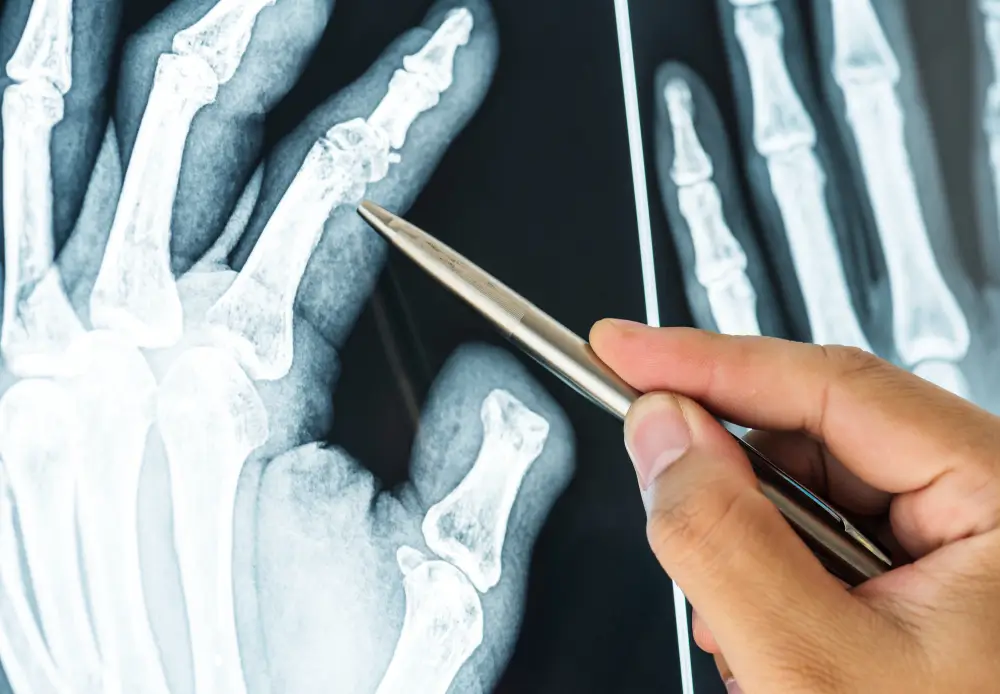
You went for your usual run, or maybe you simply increased your walking distance last week, and now there’s a dull, nagging ache in your shin or foot that won’t go away. It gets worse with activity and eases with rest, but it never fully disappears. This is one of the most common ways a hairline (stress) fracture announces itself, and it’s far more common than most people realise.
A hairline (stress) fracture is a thin crack in a bone caused by repeated force rather than a single traumatic blow. Experts estimate stress fractures account for roughly 20% of all sports injuries, making them one of the most frequent overuse conditions seen in active people, athletes, and even office workers who suddenly ramp up exercise. In this guide, we’ll break down what a hairline (stress) fracture actually is, why it happens, how doctors diagnose it, and the exact steps you can take to heal faster and avoid a repeat injury.
What Is a Hairline (Stress) Fracture?
A hairline fracture is a small crack that develops in a bone after it’s exposed to repetitive stress over time, rather than one sudden impact. Unlike a broken bone from a fall or collision, a stress fracture builds gradually as microscopic damage accumulates faster than the bone can repair itself.
Bone is living tissue that constantly remodels itself, breaking down old cells and building new ones. When you push a bone with repeated, high-impact activity before it has time to adapt, tiny cracks form in the outer layer, called the cortex. If the activity continues without adequate rest, that microdamage can progress into a full hairline crack, and in rare cases, a complete break.
Stress Reaction vs. True Stress Fracture
Doctors often describe an early, milder stage called a ‘stress reaction,’ where bone swelling and pain appear before any visible crack forms on an X-ray. If the underlying cause isn’t addressed, a stress reaction can progress into a true hairline fracture, which is why early intervention matters so much.
What Causes a Hairline (Stress) Fracture?
Stress fractures develop when the forces on a bone repeatedly exceed its capacity to heal itself. This imbalance usually comes from a combination of how much stress is applied and how well-prepared the bone is to handle it.
Intrinsic Risk Factors
- Female sex, particularly athletes with irregular menstrual cycles or low energy availability
- Low bone density or osteoporosis, which weakens the bone’s structural capacity
- Flat feet or high, rigid arches that alter how force travels through the leg and foot
- A history of a previous stress fracture, which raises the risk of another
- Nutritional deficiencies, especially low calcium and vitamin D intake
Extrinsic Risk Factors
- Suddenly increasing the intensity, duration, or frequency of exercise
- Switching to a harder training surface, such as concrete instead of a track
- Wearing worn-out or unsupportive footwear
- Repetitive occupational movement, such as standing or walking for long shifts
- Military-style training involving long marches with heavy loads
Runners, dancers, gymnasts, and military recruits are especially prone to this injury because their routines involve constant, repetitive impact on the same bones. That said, anyone who ramps up physical activity too quickly, including someone starting a new fitness routine, can develop a hairline (stress) fracture.
Symptoms of a Hairline (Stress) Fracture
The hallmark symptom of a stress fracture is a dull, localized pain that gradually worsens with weight-bearing activity and improves with rest. Because the onset is so gradual, many people initially mistake it for ordinary muscle soreness.
- Pain that starts during or after activity and slowly intensifies over days or weeks
- Tenderness at a specific, pinpoint spot on the bone rather than a broad area
- Mild swelling or bruising around the affected site
- Pain that occurs even at rest or during the night, in more advanced cases
- A dull ache that returns each time activity resumes, even after a short break
If you press directly on the painful spot and it produces sharp, focused tenderness, that’s a strong clue the issue lies in the bone rather than a muscle or tendon. Persistent pain that doesn’t improve after a few days of rest is a signal to get it checked rather than push through it.
Where Do Hairline (Stress) Fractures Commonly Occur?
Stress fractures overwhelmingly affect the weight-bearing bones of the lower body, since these bones absorb repeated impact during walking, running, and jumping. In athletes, the tibia, metatarsals, pelvis, and femur are the most frequently affected bones, and the injury appears on both sides of the body in about 16% of cases.
| Bone / Location | Common Population | Typical Symptom |
| Tibia (shin bone) | Runners, new exercisers | Ache along the shin that worsens with running |
| Metatarsals (foot) | Runners, dancers, walkers | Forefoot pain that eases with rest |
| Calcaneus (heel) | Runners, military recruits | Pain on the inner or outer heel with impact |
| Femur (thigh bone) | Distance runners | Deep groin or thigh pain, harder to pinpoint |
| Lumbar spine (pars) | Gymnasts, cricketers, divers | Lower back pain with extension movements |
How Is a Hairline (Stress) Fracture Diagnosed?
Diagnosing a stress fracture usually follows a clear, step-by-step process. Here’s what to expect at a clinic or hospital:
- Clinical history: Your doctor asks about recent changes in activity, training load, footwear, and diet.
- Physical examination: A focused pressure test on the bone helps pinpoint the exact site of tenderness.
- Imaging: X-rays are usually done first, though a hairline fracture may not be visible for two to three weeks.
- MRI or bone scan: If X-rays appear normal but suspicion remains high, an MRI is the most sensitive tool for catching early stress reactions and fractures.
- Additional workup: In recurrent cases, doctors may check bone density and nutritional or hormonal factors to identify an underlying cause.
An MRI is generally preferred over a bone scan today because it detects bone marrow swelling early and doesn’t involve radiation, making it a safer option for repeated monitoring.
Hairline (Stress) Fracture vs. Sprain vs. Complete Fracture
It’s easy to confuse a stress fracture with a sprain or a complete break, since all three cause pain around a joint or bone. The table below highlights the key differences to help you understand what you might be dealing with.
| Feature | Hairline (Stress) Fracture | Sprain | Complete Fracture |
| Onset | Gradual, over days/weeks | Sudden, after a twist | Sudden, after trauma |
| Pain location | Pinpoint on bone | Around a joint/ligament | At the break site |
| Weight-bearing | Painful but often possible | Painful, variable | Usually not possible |
| Typical cause | Repetitive overuse | Single twisting injury | Fall, blow, or accident |
| Recovery time | 6-8 weeks on average | 1-4 weeks | 6-12+ weeks |
Treatment and Recovery Timeline
The good news is that most hairline (stress) fractures heal well with non-surgical treatment, provided you give the bone enough time and reduce the load on it early. The general approach follows a simple framework.
Immediate Care: Protect and Rest
- Stop the activity that caused the pain as soon as possible
- Use crutches or a protective boot if walking causes pain
- Apply ice to reduce swelling and discomfort in the first few days
- Avoid over-the-counter pain relief that masks pain enough to keep you active on the injury
Recovery Phase: Rebuild Gradually
- Begin gentle range-of-motion and low-impact exercises like swimming or cycling once pain subsides
- Reintroduce weight-bearing activity gradually, guided by pain response
- Add calcium- and vitamin D-rich foods, or supplements if a doctor recommends them
- Address footwear, training surfaces, or biomechanical issues that contributed to the injury
Most stress fractures in the lower leg and foot heal within six to eight weeks, though high-risk fractures, such as those in the femoral neck or the front of the tibia, may need longer, more cautious management because they’re more prone to complications if activity resumes too soon.
Expert Insight
According to guidance published by the Mayo Clinic, people who’ve already had one stress fracture face a meaningfully higher risk of developing another, which is why addressing the root cause, not just the current injury, is considered essential to long-term recovery. Clinical reviewers at Patient.info similarly note that stress fractures are not full-thickness breaks, but without correct management they can progress into one, reinforcing why early diagnosis and a proper rest period matter more than pushing through the pain.
Prevention: Reducing Your Risk
Preventing a hairline (stress) fracture largely comes down to giving your bones time to adapt to new demands. A few consistent habits go a long way.
- Increase training volume or intensity by no more than about 10% per week
- Replace worn athletic shoes every 300-500 miles of use
- Cross-train with low-impact activities to reduce repetitive strain on the same bones
- Ensure adequate calcium, vitamin D, and overall caloric intake, especially for female athletes
- Get any persistent, localized bone pain evaluated early rather than waiting it out
Key Takeaways
- A hairline (stress) fracture is a small bone crack caused by repetitive overuse, not a single injury
- Pinpoint pain that worsens with activity and improves with rest is the classic warning sign
- X-rays can miss early stress fractures; an MRI is often needed for a confirmed diagnosis
- Rest, activity modification, and gradual reloading typically lead to full recovery in 6-8 weeks
- Addressing footwear, training load, and nutrition helps prevent the injury from recurring
Frequently Asked Questions
What does a hairline (stress) fracture feel like?
It typically feels like a dull, localized ache that builds gradually with activity and settles down with rest, rather than a sudden sharp pain.
Can a hairline fracture heal on its own without treatment?
Most stress fractures heal with rest, activity modification, and protective measures like a boot or crutches, but ignoring the pain and continuing to train on it can turn a hairline crack into a complete fracture.
How long does a stress fracture take to heal?
Most lower-leg and foot stress fractures heal in about six to eight weeks, though high-risk locations such as the femoral neck can take longer and need closer monitoring.
Will an X-ray always show a hairline fracture?
Not necessarily. Early stress fractures are often invisible on X-ray for the first two to three weeks, which is why an MRI is used when clinical suspicion is high despite a normal X-ray.
Is walking okay with a suspected stress fracture?
It depends on the pain level and location. If walking causes pain, it’s best to use crutches or a protective boot and get it evaluated rather than continuing to bear weight on it.
Who is most at risk of a hairline (stress) fracture?
Runners, dancers, gymnasts, and military recruits face the highest risk due to repetitive impact, along with anyone who rapidly increases activity level without adequate conditioning.
Conclusion: Don’t Ignore the Ache
A hairline (stress) fracture might start as a small, easy-to-dismiss ache, but it’s your bone’s way of signalling that it’s under more stress than it can handle. Catching it early, resting appropriately, and addressing the underlying cause are the difference between a six-week recovery and a much longer, more complicated one.
If you’re dealing with persistent, localized bone pain that isn’t improving with rest, don’t wait it out. Use our free symptom checker and other health tools on MyHealthChart to better understand your symptoms, and consult a qualified doctor for a proper diagnosis and personalised treatment plan.

Dr. David Zukor is an Orthopaedic Surgeon specializing in hip and knee replacement surgery. He practices privately at Westmount Square and uses his platform to share educational content related to orthopaedic health and joint replacement.